
Building continuous customer engagement
Part 1: Turning a Product Conference into a Co-Creation Workshop
Role
User Experience Designer
Team
2 Designers,
1 UX Leadership
Timeline
2019
Project
UX Research

I co-led a research strategy from scratch. UX had no access to customers, so we utilized a corporate event into a scalable co-creation workshop that defined three new strategic product initiatives.
The Problem: Designing in the Dark
We were kicking off a next-generation project—but had no direct access to customers. We relied on secondhand information. Feedback came through sales, support, or stakeholder assumptions. While well-intentioned, these inputs lacked the depth and context needed to understand real workflows.
We weren’t just missing feedback. We were missing how the system was being used in the real world.
The Opportunity
The issue wasn’t a lack of research methods; it was a lack of access and proximity to users.
Around that time, we had an upcoming customer conference where dozens of customers would be present.
Instead of treating it as a passive networking event, it was an opportunity to turn into a structured hands-on co-creation workshop.
We designed the workshop to achieve the following objectives:
-
Understand real workflows
-
Validate pain points
-
Gather direct feedback
-
Ideate solutions together
My Role
-
Planned the workshop, including intro calls
-
Defined topics and aligned facilitators
-
Facilitated 1 of 4 groups during the workshop
-
Established a customer database / research repository
-
Synthesized findings and co-delivered internal presentations
-
Partnered with PM to frame opportunities
-
Created the "Day in the Life" visual artifact
Designing the Workshop
To make this effective, I teamed up with another UX designer.

Pre-work: Build Rapport and Establish Context
Long before the event, I conducted intro calls with customers to understand:
-
Their operational scale
-
System pain points
-
Existing workflows and constraints
This created a baseline for each participant—so we weren’t starting from zero.
Participants came aligned, and conversations started at a deeper level based on pre-selected topics.

Workshop Design
I adopted the Double Diamond approach and designed the workshop in two phases:
-
Problem definition — Challenge mapping for structured thinking
-
Solution exploration — Crazy 8 to rapidly generate and iterate on ideas


Workshop in Action

The workshop created a rare environment. Customers were vocal and validated each other’s pain points.
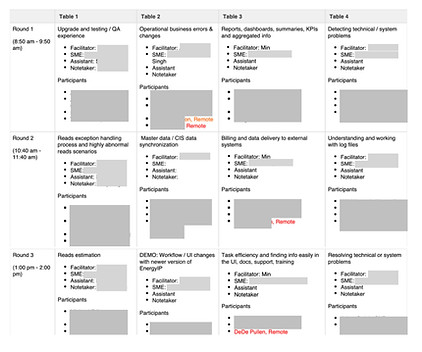
4 facilitators covered 12 topics

Research findings repository
What We Uncovered
Low trust in data readiness
Users couldn't confidently determine when data was ready for billing
Rising system complexity (EVs, solar)
Existing tools couldn't keep up
Configuration complexity and risk
Errors had cascading downstream impact
Event fatigue and noise
Errors had cascading downstream impact
Outcome
I synthesized the findings into a structured report and aligned cross-functional teams around the implications.
This contributed to:
-
3 new strategic product initiatives
-
A shared understanding of user workflows and priorities
-
Stronger alignment between UX, PM, and Engineering
Stretch Goal
To make the insights actionable long-term, I created a “Day in the Life” map. This mapped end-to-end user workflows, key breakdown points, and opportunities across the system.
It became a shared reference point across teams—helping connect fragmented problems into a more cohesive product vision.

... was an absolute eye-opener and hands-down the most engaging session I’ve attended in a long time! Being able to map out our process directly with the design team felt incredibly collaborative, and I truly hope this is just the beginning of a continuous conversation.
Part 2: Tech Talk
Role
User Experience Lead
Team
Solo (+ Product, Marketing)
Time frame
Recurring every 6 weeks
Project
UX Research
Co-creation workshop surfaced valuable insights on product direction and usability, but feedback showed a gap: customers wanted continued dialogue and visibility beyond the workshop. However, there was no structured way to maintain that engagement or gather ongoing input.
I initiated Tech Talk, a bi-monthly webinar series designed to extend customer conversations year-round. Each session focuses on a specific topic—such as real-world workflows or new feature feedback—to foster peer learning and enable direct collaboration between customers and the Product team.
Goals
-
Deepen understanding of customer use cases and pain points
-
Gather insights to guide product strategy and design decisions
-
Validate new experiences (e.g., MDM UI) through live feedback
-
Create an open forum for customers to connect with each other and with us
Process
I collaborated across Product and Marketing to:
-
Identify high-value topics from customer surveys, event feedback, and upcoming releases
-
Design interactive, discussion-led webinar formats (not presentations)
-
Facilitate live sessions using polls and Q&A to capture qualitative insights
-
Synthesize outcomes into actionable product improvements and share recordings and summaries via the Customer Portal

Used poll data to prioritize features and guide the upcoming release plan.


Produced documentation detailing usability findings and subsequent action plans.


Maintain a comprehensive record of topics for discussion and those already covered.
Impact
Tech Talk established a sustainable customer feedback loop, strengthening engagement, improving visibility into design decisions, and directly informing product roadmap priorities.